Engineers warn regulator cuts could jeopardise electricity supply, bushfire safetyEngineers warn regulator cuts could jeopardise electricity supply, bushfire safety

Electricity price cuts proposed by the regulator could compromise Canberra’s power supply, lead to thousands of job losses and pose “catastrophic” safety risks to NSW and ACT residents if they were introduced, the engineers’ union has warned.


Professionals Australia has weighed in on the Australian Energy Regulator’s draft decision to slash operating and expenditure costs on NSW and ACT electricity distributors by more than one-third for 2014-19.


In November, the regulator said the revenue cuts to ActewAGL, Ausgrid, Endeavour Energy, Essential Energy and TransGrid would contribute to a 10 per cent drop on the costs of electricity bills in 2015/16, followed by small increases over the next three years.


But union officials have raised concerns over the impact of the pricing restrictions on employment and infrastructure in a submission to the regulator, and detailed “significant and numerous risks to safety, reliability, quality and professional capacity” the proposal could generate across the sector.


A spokesman for the regulator said it was currently assessing the union’s submission.


Professionals Australia chief executive Chris Walton said members were “extremely concerned” the cuts would compromise long-term electricity infrastructure management and “prioritise cost over safety and reliability”.

The regulator is not only proposing savage cuts, but they have given no transition period for the industry to step toward change.

“This will result in important work being abandoned immediately, and increase risk and danger exponentially.

“Professional engineers are very concerned that these cuts would wipe out huge amounts of technical expertise, knowledge and capacity across the industry, and make it very difficult to deliver safe and reliable electricity into the future or in rural and regional areas.”

His grievances echoed concerns raised by ActewAGL soon after the draft revenue reduction was announced last year.

While electricity customers would save an average of $162 a year on their power bills, the ACT’s energy provider said Canberra’s electricity supply would be at risk, the utility’s staff numbers would be “slashed and burned” and executives pay reduced by 40 per cent.

The union’s submission said staff and funding cuts, coupled with ageing electrical infrastructure in NSW and the ACT, would increase the risk of a major disruption to the electrical supply in NSW and the ACT, the submission said.

“The NSW and ACT systems have operated for many decades without widespread interruption, but there have been a number of near misses.

“This good performance has been due to the proper provision of human and financial resources and a high level of skill and commitment of staff in utilities to the goal of providing an essential public service.

“It is critical that expertise and skills are not jeopardised due to downsizing and short-term financial restrictions, because once lost, such skills and expertise will never be regained.”

The union expected 4000 jobs would go under the proposal, a move which the union said would have a devastating impact on each of the businesses’ ability to provide safe, reliable and affordable power.

“If enacted these cuts would heighten risk, danger and the potential for catastrophic failure – in an industry that is at extreme risk of being depleted of professional capacity,” the submission said.

“The cuts would also likely mean TransGrid would need to abandon 85 per cent of its bushfire mitigation program.

“Cutting bushfire mitigation work is absolute madness, when you consider the Royal Commission into Black Saturday linked the deaths of 173 people and the $4.4 billion cost of the disaster, directly to Victoria’s ageing electricity assets.”


The union, which represents thousands of engineers who build and maintain electricity assets, also called for the regulator to meet with professional engineers and to carry out a risk analysis over the proposal.


This article was originally posted on Canberra Times News Website

Contact Us

Zenergy News
Fake Safety Certificates: An HSE Hiring Wake-Up Call
By Dean Woods • October 19, 2026
WorkSafe Victoria is investigating fake safety qualifications. How employers should verify tickets, licences and real competency when hiring HSE talent.
Zenergy Take 5: WHS News for the Week of 19 October 2026
By Dean Woods • October 19, 2026
Queensland’s psych injury claims shake-up, fake safety certificates under investigation, fresh job market data and this week’s featured HSE role.
Zenergy Congratulates the 2026 AWHSA Finalists
By Dean Woods • October 13, 2026
Zenergy is proud to sponsor the 2026 Australian Workplace Health & Safety Awards. Meet the 52 finalists ahead of the Sydney gala on 12 November.
By Dean Woods • October 13, 2026
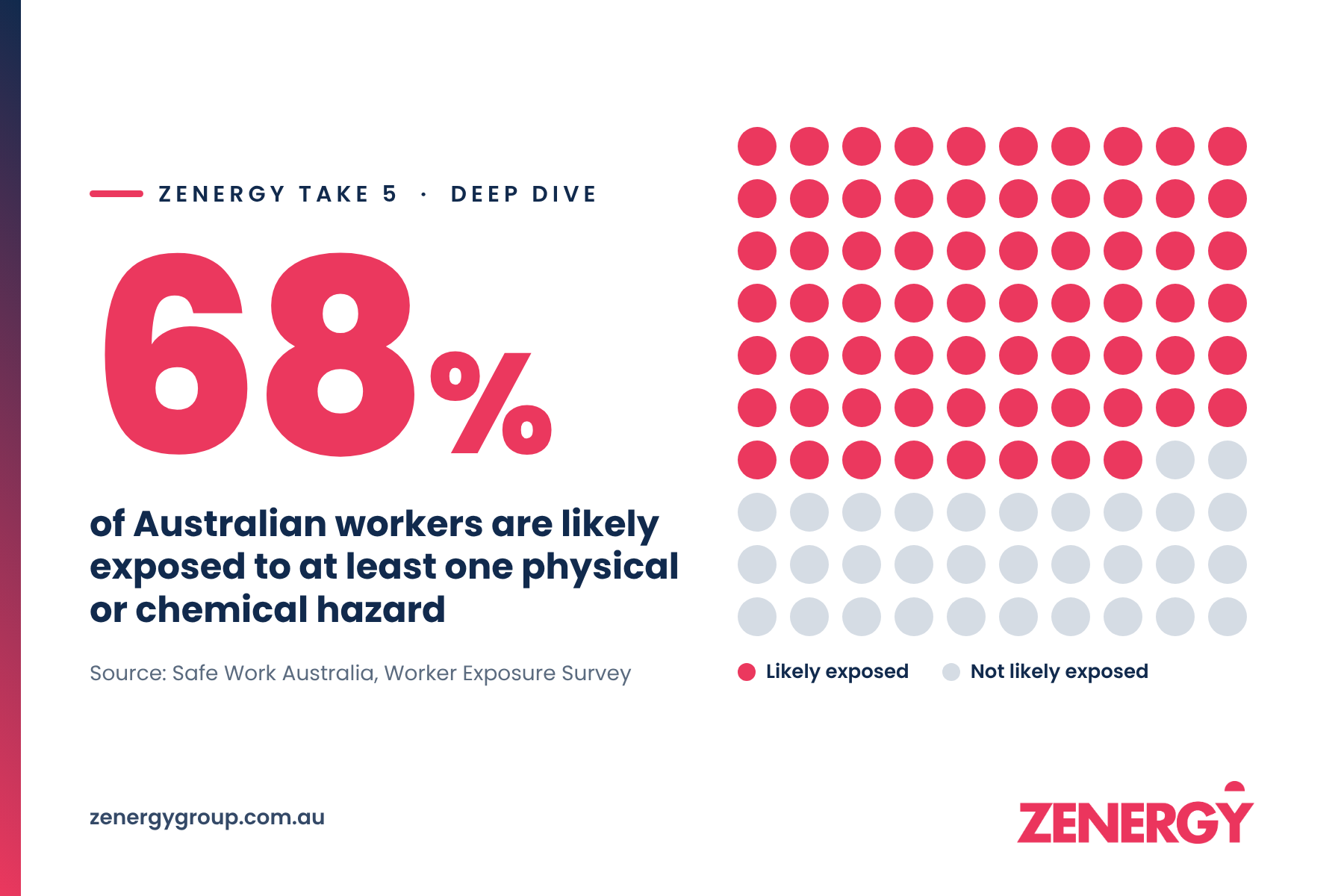
Welcome to Take 5, Zenergy's weekly five-minute scan of what's moving in Australian workplace health and safety, workers compensation and people & culture — five items, one featured senior role, every source named. This week: a hard regulatory deadline lands on the calendar, Safe Work Month hits its stride, and Safe Work Australia publishes the clearest picture in years of who is actually exposed to harm at work. 1. New workplace exposure limits commence 1 December — including Australia's first diesel particulate limit The transition period for Safe Work Australia's updated workplace exposure limits (WELs) for airborne contaminants ends on 1 December 2026. The list introduces Australia's first national exposure limit for diesel particulate matter — 0.01 mg/m³, measured as respirable elemental carbon — alongside revised limits for a range of other contaminants. Regulators are telling duty holders to use the remaining weeks to review exposure monitoring, confirm controls are effective, and prioritise elimination and engineering controls over reliance on RPE. If your operations involve diesel plant in enclosed or poorly ventilated environments — distribution centres, tunnels, underground mining, workshops — this is the compliance item to table at your next leadership meeting. Safe Work Australia has published guidance and a transition toolkit, and state regulators including SafeWork SA have flagged the change, as has NOPSEMA for offshore operators. Sources: Safe Work Australia — Changes to Workplace Exposure Limits (safeworkaustralia.gov.au); SafeWork SA — Get ready for new Workplace Exposure Limits (safework.sa.gov.au); NOPSEMA — Diesel engine emissions: new workplace exposure limit takes effect December 2026 (nopsema.gov.au). 2. Dates ahead: Safe Work Month's “for health” week and World Mental Health Day National Safe Work Month is underway, with Safe Work Australia's 2026 theme “Safe work is for life” running week-by-week focuses: “for health” (week two, this week), “for the future” (week three) and “for all” (week four). World Mental Health Day falls on Saturday 10 October, inside Mental Health Month — a natural prompt to put psychological health on the toolbox agenda, not just the poster wall. Regulators are active too: SafeWork NSW opened the month with a compliance operation targeting the meat processing sector. Sources: Safe Work Australia — National Safe Work Month (safeworkaustralia.gov.au/national-safe-work-month); SafeWork NSW — news, 1 October 2026 (safework.nsw.gov.au). 3. People & culture: FWO recovers $453 million for workers in 2025–26 The Fair Work Ombudsman's 2025–26 results, released 14 September, show $453 million recovered for underpaid workers across the year, with Ombudsman Anna Booth urging employers to find “compliance common ground”. For employers, the signal hasn't changed: payroll governance, award classification and record-keeping sit alongside WHS as enterprise-level compliance risks — and the regulator's recovery capability keeps growing. Worth a standing item on the people & culture risk register, especially for businesses with large award-covered or labour-hire workforces. Source: Fair Work Ombudsman media release, 14 September 2026 (fairwork.gov.au/newsroom). 4. Job market pulse: national vacancies ease, HSE demand holds The ABS's August 2026 Job Vacancies figures (released 1 October) show 325,000 vacancies nationally — down 0.9% over the quarter and 1.3% over the year, and 31.2% below the May 2022 peak. Private sector vacancies fell 2.0% for the quarter while public sector vacancies rose 7.8%. Health care and social assistance remains the deepest vacancy pool at 54,300. Against that gently easing backdrop, safety hiring is holding its ground from WHS advisors in Melbourne manufacturing to safety leadership in Queensland logistics — a spread we read as steady, sector-broad demand for proven operators rather than a hiring spike. Sources: ABS — Job Vacancies, Australia, August 2026 (abs.gov.au); 5. Industry story of the week: 68% of workers likely exposed to at least one hazard Safe Work Australia's newly published Worker Exposure Survey finds 68% of Australian workers are likely exposed to at least one physical or chemical hazard at work, with 28.9% experiencing high-level exposure. Solar UV is the most common hazard (an estimated 4.87 million workers), silica exposure covers an estimated 2.04 million workers and is heavily concentrated in construction and mining, and apprentices and trainees are disproportionately exposed across heat, silica, lead and asbestos. Construction, agriculture and mining are the industries most likely to see multiple hazard exposure. It's the week's most important read for HSE leaders — and the subject of this week's Zenergy deep-dive, where we unpack what the numbers mean for exposure monitoring, young-worker supervision and the 1 December exposure limit deadline. Sources: Safe Work Australia — Worker Exposure Survey (safeworkaustralia.gov.au); Safety Solutions, 28 September 2026 — “Over two-thirds exposed to a physical or chemical hazard, workers survey reveals”
By Dean Woods • October 7, 2026
Safe Work Australia's Worker Exposure Survey finds 68% of workers exposed to hazards. What HSE leaders should do before new limits land on 1 Dec.
City skyline at sunset with tall modern buildings under a colorful orange and blue sky
September 16, 2026
Explore the latest Safe Work Australia updates for 2026, including WHS penalties, incident notification, AI, chemical exposure limits and regulatory changes.
More Posts